
Male pattern baldness (androgenetic alopecia) follows a predictable progression classified by the Norwood scale. Knowing your stage isn't just academic — it determines which treatments are likely to help, which aren't worth trying, and how aggressive your approach needs to be.
The Norwood Scale
The Hamilton-Norwood scale classifies male pattern baldness into 7 stages:
Stage I: No significant recession. Full juvenile or mature hairline. No treatment needed.
Stage II: Slight temple recession creating a mild M-shape. Many men stabilize here. This is the ideal time to start a preventive approach if your family history suggests further progression. See our full treatment breakdown for options at each stage.
Stage III: First stage clinically classified as baldness. Temple recession deepens. Vertex (crown) thinning may begin (Stage III Vertex variant). This is the stage where intervention makes the biggest difference.
Stage IV: Significant frontal recession with a band of hair separating the front and crown loss areas.
Stage V: The separating band narrows. Frontal and crown zones begin merging.
Stage VI: The bridge is gone. Hair loss across the top is extensive.
Stage VII: Most advanced stage. Only a horseshoe-shaped band remains around the sides and back.
Treatment by Stage
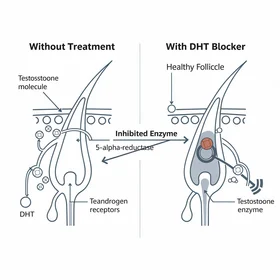
Not every treatment makes sense at every stage. Here's a realistic breakdown:
| Stage | Realistic Goal | Recommended Approach |
|---|---|---|
| I–II | Prevention / maintenance | Natural DHT management approach (like Procerin) + good scalp care. Monitor for progression. No aggressive intervention needed. |
| III | Halt progression, possible regrowth | DHT management (natural or pharmaceutical) + topical activator. This is where combination approaches have the best risk/reward ratio. |
| IV | Slow progression, partial regrowth | Stronger DHT intervention — consider topical finasteride + minoxidil (like Procerin Rx). Combination of oral + topical. |
| V–VI | Stop further loss | Maximum medical intervention + potential surgical candidacy evaluation. DHT management preserves what remains; transplant can restore density in key areas. |
| VII | Maintenance only | Surgery with realistic expectations about donor hair limits. Medical therapy to maintain remaining hair. |
Typical Progression Timeline
Male pattern baldness can begin as early as the late teens, though most men first notice changes in their 20s or 30s. The rate of progression varies enormously — some men go from Stage II to V in 5 years; others take 30 years to progress the same amount.
By age 50, roughly half of men show visible thinning. By 70, about 80%. Earlier onset generally correlates with more extensive eventual loss — which is another argument for early intervention.
The Mature Hairline vs. Pathological Recession

Not every receding hairline is male pattern baldness. Between ages 17–25, most men's hairlines naturally mature — moving about 1–1.5cm upward from the juvenile position. This is normal and stabilizes.
Signs that recession is pathological rather than maturational:
- Temple recession is asymmetric or deepening beyond a mild M-shape
- Hair at the recession edge is finer and shorter than hair behind it (miniaturization)
- Crown thinning is also present
- Family history of significant hair loss on either side
- Recession is progressive — it keeps getting worse over months/years
A dermatologist with a dermoscope can definitively distinguish between the two by examining follicle diameter ratios.
Who Should Consider Treatment — And Who Shouldn't
Not every man experiencing hair loss needs treatment, and not every treatment is right for every situation. Matching the approach to your specific profile is the difference between a worthwhile investment and wasted money.
Best for: Early-Stage Prevention (Norwood II–III)
Natural DHT-management supplements are best for men in the earliest stages of thinning who want to slow progression without prescription medication. Products like Procerin are ideal for this group — the combination of oral DHT inhibitors and topical activators works most effectively when follicles are still active and miniaturization is in early stages. This approach is also recommended for men with a strong family history who want to start preventive management before significant loss occurs.
Best for: Active Loss (Norwood III–V)
Prescription-strength DHT blockers (finasteride, topical formulations like Procerin Rx) are right for men experiencing measurable progression. This group benefits most from aggressive DHT suppression combined with minoxidil. If you're losing ground despite natural approaches, stepping up to pharmaceutical-grade treatment is appropriate. PRP therapy may be worth considering as an adjunct for men in this range who want to maximize results.
Best for: Advanced Loss (Norwood V–VII)
Hair transplant surgery is best for men with stabilized advanced loss who have realistic expectations about donor hair limitations. It's ideal for candidates who have been on DHT-management treatment for at least 12 months (to stabilize further loss before surgery) and who have sufficient donor density in the occipital region.
Who Should Not Pursue Aggressive Treatment
Treatment is not ideal for several groups:
- Men under 20 — hair loss patterns are not yet established; early aggressive treatment can mask the actual trajectory and complicate future planning
- Men with diffuse unpatterned alopecia (DUPA) — donor hair is also affected, making transplant surgery unreliable
- Men expecting a cure — if you're not prepared for ongoing management, starting treatment will lead to disappointment when results require continued use
- Men with alopecia areata — this autoimmune condition requires immunological treatment, not DHT management; standard baldness treatments are not effective
- Those with unrealistic timeline expectations — treatment takes 3–6 months for initial results and 12+ months for full effect. It is not right for anyone looking for rapid cosmetic change
A board-certified dermatologist specializing in hair loss can help determine who should pursue which treatment path based on your specific pattern, stage, family history, and health profile. For actionable strategies specifically focused on hairline recession, comprehensive receding hairline guide covers evidence-ranked treatment approaches.