
The word 'baldness' covers several distinct conditions, but when most men search for a baldness cure, they're dealing with androgenetic alopecia — male pattern baldness. Understanding why it happens explains both why a cure is so elusive and why certain treatments work better than others.
The DHT Mechanism
Male pattern baldness is driven by dihydrotestosterone (DHT) — a potent androgen produced from testosterone by the enzyme 5-alpha-reductase. In men with a genetic susceptibility, DHT binds to androgen receptors in hair follicles along the hairline and crown, triggering a process called follicle miniaturization.
Each hair growth cycle, affected follicles produce slightly thinner, shorter, lighter hair. Eventually the follicle produces only fine vellus hair, then goes dormant. This is progressive and — without intervention — irreversible once the follicle fully shuts down.
The key word is genetically susceptible. Two men with identical testosterone and DHT levels can have completely different outcomes. The difference is how their follicle androgen receptors are programmed to respond. This genetic component is why baldness runs in families — and why DHT-lowering treatments work for some men better than others.
Types of Baldness
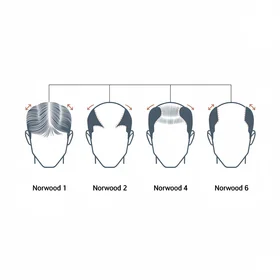
Androgenetic alopecia accounts for approximately 95% of male hair loss. It follows predictable patterns classified by the Norwood scale (7 stages, from mild temple recession to extensive loss).
Alopecia areata is an autoimmune condition causing patchy hair loss. It's unrelated to DHT and requires different treatment approaches.
Telogen effluvium is temporary shedding caused by stress, illness, medications, or nutritional deficiency. It's usually reversible once the trigger is addressed.
Traction alopecia results from chronic physical tension on hair (tight hairstyles, extensions). It's preventable and sometimes reversible.
This site focuses primarily on androgenetic alopecia — the DHT-driven type — because it's what the vast majority of men searching for a 'baldness cure' are experiencing.
Why There's No Simple Cure
A true cure would require one of two things: permanently reprogramming the genetic sensitivity of follicle androgen receptors, or eliminating DHT from the scalp without affecting it elsewhere in the body. Neither is currently possible.
Research is progressing on both fronts — gene therapy approaches and stem cell-based hair regeneration are in early stages — but nothing is close to clinical availability. The treatments that exist today manage the condition rather than cure it. They work by reducing DHT (slowing follicle miniaturization), stimulating follicle activity (extending the growth phase), or physically relocating DHT-resistant follicles (transplant surgery).
That's not nothing — managing the condition effectively can preserve your hair for decades. But it does mean that stopping treatment means the underlying process resumes. This is true for every current option, from over-the-counter supplements to prescription medications.
When to Start Treatment

The most important factor in treating baldness isn't which product you choose — it's when you start. Treatments work by preserving and revitalizing follicles that still have function. Once a follicle fully miniaturizes and goes dormant, it's effectively gone. No topical, pill, or supplement can bring it back.
This is why early intervention matters disproportionately. A man who starts addressing DHT at Norwood II has far more to work with than one who waits until Norwood V. The best time to start was when you first noticed thinning. The second-best time is now. To understand where you fall on the progression scale, see our guide to male pattern baldness stages.